If you've read what 'architecture' really means in business, you know the landscape: six architecture disciplines, each essential, each with a blind spot. Enterprise architects optimize application portfolios. Business architects map capabilities. Solution architects design systems. Data architects govern information. Process architects standardize workflows. Organizational designers shape structures.
All valuable. None sufficient. Because nobody is responsible for how all of these architectures work together as an operating model.
That's the gap this article addresses.
The building architect metaphor
Think of a building architect. The structural engineer calculates load-bearing requirements. The electrician designs wiring. The plumber designs water systems. The HVAC specialist designs climate control. Each is an expert in their domain.
But without a building architect who integrates all of these systems into a coherent design, you get a building where the plumbing conflicts with the electrical, the HVAC doesn't account for the structural layout, and the whole thing is technically sound in parts and dysfunctional as a whole.
This is exactly what happens in most large organizations. Each architecture discipline optimizes its own dimension. Nobody holds the integrating design.
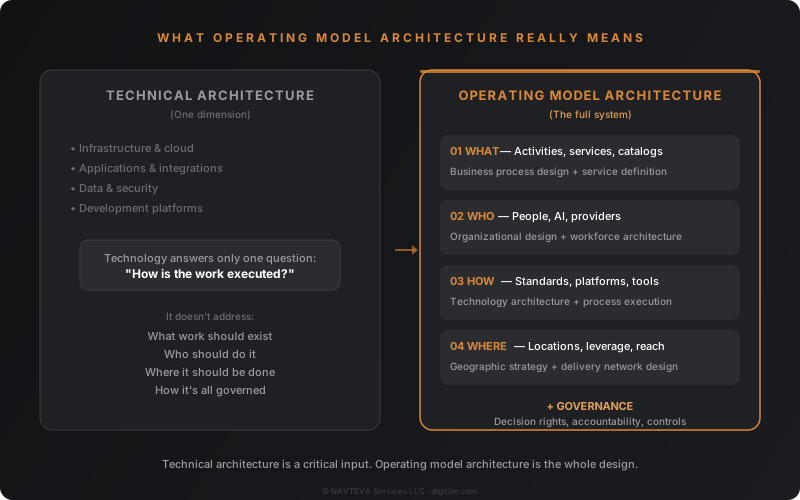
Operating model architecture: the integrating discipline
Operating model architecture doesn't replace enterprise architecture, business architecture, or any of the other disciplines. It integrates them. It's the design of the full target operating model — how all the pieces work together to create an organization that operates coherently.
The integration happens across four dimensions that every operating model must address.
01 — WHAT work gets done
Activities, responsibilities, service catalogs, process taxonomies. This is the foundation that everything else connects to. Business architecture and process architecture provide critical input here. Operating model architecture ensures these inputs produce a coherent definition of scope — before deciding who does the work or what technology enables it.
Organizations that skip this step end up automating processes that shouldn't exist, outsourcing work they don't fully understand, or deploying AI agents without clear accountability for outcomes. The target operating model begins here — with clarity about the work itself.
02 — WHO does the work
Employees, contractors, service providers, AI agents — organized through GBS structures, leverage ratios, supervision models, and decision rights. Including the skills, regulatory requirements, credentialing, and training each one demands. Organizational design defines the structures. Enterprise architecture identifies where technology can augment or replace human work. Operating model architecture ensures the workforce model aligns with the process design, the technology capabilities, and the geographic footprint.
03 — HOW work is executed
On paper, by phone, in ERP, through RPA, via APIs, or by AI agents — all sharing common operating and data standards, processes, job aids, platforms, and communication protocols. This is where technical architecture, solution architecture, and data architecture are essential inputs. Operating model architecture ensures technology decisions are made in context — not just optimized for system performance, but designed to support the full operating model.
04 — WHERE work is done
Onshore, nearshore, offshore, remote. Site selection, time zones, culture, skill clustering and saturation, risk profile, service redundancy. Enterprise architecture maps the infrastructure. Organizational design places the teams. Operating model architecture ensures location decisions account for all four dimensions — not just cost.
Why the integration breaks down
Consider a cloud migration where solution architects designed an elegant microservices architecture — modular, scalable, technically sophisticated. But nobody redesigned the operating model to match. The organizational structure still reflected the old monolithic system. Process handoffs hadn't been re-mapped. Geographic decisions hadn't been revisited. The technology was modern. The operating model was legacy. The organization captured maybe twenty percent of the potential value.
This happens because each architecture discipline operates independently. When organizations treat 'architecture' as purely technical, they make technology decisions in isolation from the target operating model. A cloud migration becomes an IT project instead of an opportunity to redesign how work flows. An AI deployment becomes a pilot instead of an operating model shift. An outsourcing contract gets signed based on cost instead of architectural fit.
Operating model architecture prevents this by designing all four dimensions as an integrated system. Technology decisions are made in context. Organizational design accounts for the technology. Geographic decisions account for the process. Every dimension reinforces the others.
Architecture through technology waves
Every major technology wave reshapes the operating model — not just the technology layer. ERP didn't just change systems. It enabled shared services, which changed who does the work and where. Workflow automation didn't just speed up processes. It enabled new governance models and quality frameworks. Cloud computing didn't just reduce infrastructure costs. It made geographic distribution viable at scale.
AI is the latest wave, and it's touching all four dimensions simultaneously. It's changing what work is worth doing at all — as AI agents take over tasks that humans used to perform. It's changing who does the work — as the workforce model shifts to include AI alongside humans and service providers. It's changing how work is executed — as platforms, automation layers, and decision systems evolve. And it's changing where work is done — as remote AI execution decouples work from physical location.
Organizations that treat AI as a technology project — a solution architecture problem — will miss the operating model implications. They'll deploy AI agents without redesigning accountability. They'll automate processes without rethinking the target operating model and workforce design. They'll capture a fraction of the value.
Each wave touches all four dimensions. Organizations that treat it as a technology project miss three-quarters of the value.
What this means in practice
We work with enterprise architects and business architects, not against them. Every architecture discipline brings essential expertise. The problem isn't the disciplines — it's the missing integration layer.
A diagnostic maps all four dimensions and identifies where the connections are broken — where technology decisions have been made without accounting for organizational design, where geographic strategy doesn't match the process architecture, where the workforce model hasn't kept pace with automation capabilities.
A transformation sequences changes across all four dimensions so they reinforce each other rather than creating new friction. And as AI reshapes the operating landscape, the integrating discipline becomes more critical than ever — because AI doesn't just change one dimension. It changes all of them.
Enterprise architecture tells you what technology to deploy. Business architecture tells you what capabilities to build. Operating model architecture tells you how the whole thing actually works.
Read next: Target Operating Model — what it is, what it produces, and what has changed.
Key Takeaways
- Operating model architecture integrates six architecture disciplines across four dimensions: What, Who, How, Where
- Each technology wave — ERP, workflow, cloud, AI — reshapes all four dimensions, not just the technology layer
- Organizations that treat technology adoption as a technical project miss three-quarters of the potential value
- The operating model architect integrates all dimensions the same way a building architect integrates structural, electrical, and mechanical systems into one coherent design