Global Business Services represents the evolution of cost-centric and scale driven efforts but also can be the enabler of modern extended enterprises that integrate internal and external assets
The term GBS Global Business Services emerged as companies use of low wage arrangements (ie. Outsourcers, contractors) and structures (eg. Shared Service Centers, Captive centers, Centers of Expertise) proliferated during the last decade and companies were challenged with both managing all these disparate arrangements and continuing to deliver lower costs for additional corporate functions.
The fundamental challenge addressed by GBS is managing, optimizing and evolving the wide range of third party arrangements with wage arbitrage as its main driver. When creating these arrangements, companies focused on SLA’s and contracts that would deliver lower costs and for the most part shift responsibilities to third parties they wished to hold accountable. This worked well for a while but as the number of these arrangements increased along with new global locations, third parties performing the work and functions under this model, it became clear that a sourcing arrangement governed by legal contracts and SLA’ fell dramatically short.
Shared Services
Shared Services is a method to standardize and centralize work to achieve lower costs through economies of scale. This approach was popularized in the 90’s and got a big boost with Enterprise Resource Planning (ERP) systems. It focused initially in traditional corporate functions: Finance, HR, Material, procurement and Sales administration functions.
Outsourcing and BPO
Outsourcing is defined by CIO magazine as “a business practice in which services or job functions are farmed out to a third party”. Business Process Outsourcing is a variation built around the idea of shifting entire processes or functions to a third party, as opposed to just farming out individual jobs or tasks to third parties.
When third party staff is located outside the hiring company’s country, it’s called offshoring. As most offshoring work was initially done in India, the term became synonymous with India and far away locations. Some early adopters had bad experiences and looked for international alternatives that were physically closer to home and offered a better fit to their own culture,
The term Nearshore was born as a relative term to the hiring company. Thus countries like Mexico, Colombia, Costa Rica became nearshore locations to the United States. Similarly Poland, Romania and Bulgaria will be examples of nearshore locations for the United Kingdom or Western Europe.
Companies like TCS, Wipro, Infosys, Cognizant used their low wage advantage in India to dominate these industries, growing to global behemoths with operations all over the world. They were joined by global companies like Accenture or recent entrants such as Globant that used a period of low wages in Argentina to follow the same script of Indian companies and scale globally to Billion dollar status. These days there are many BPO providers and they came in all sizes.
The Global Business Services Model
The GBS model is the key tangible outcome of Global Business Services but unfortunately it is not always articulated; or companies simply assume the model is the same as “adding up” all third party arrangements and internal Centers of Expertise rather than a well thought out and integrated Operating Model that transcends cost-cutting. In some cases companies also end up with a consultant-facilitated target model that can be quite detached from reality and internal corporate dynamics.
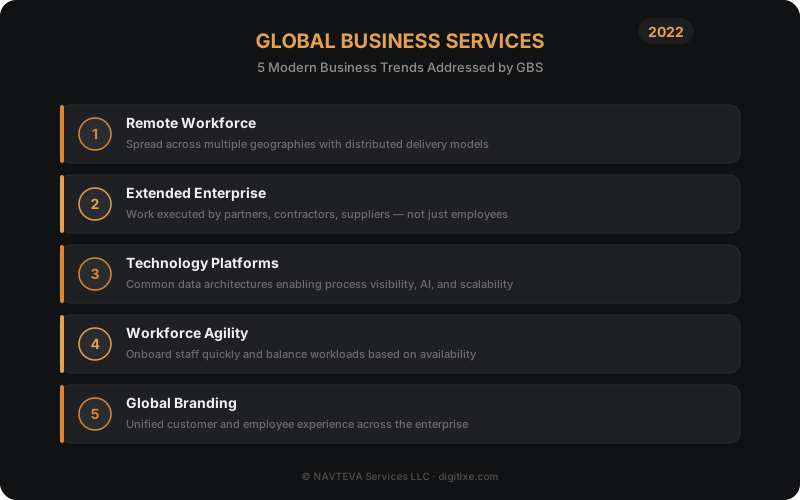
The upside of articulating a full GBS model is that in addition to being a must in terms of cost takeout, this target model will provide a great fit for modern companies in their journey to become a Digital Business. Specifically, it provides a blueprint for modern operations as it helps address 5 modern business trends.
- Remote workforce spread across multiple geographies
- Extended Enterprise/ Inverted Firm: Work executed not just by internal employees but by an entire value delivery chain of external partners, third party staff, contractors, suppliers, etc. that can make or break customer experience and continuing to manage them through SLA’s and legal/procurement departments is no longer viable
- Technology platforms with common data architectures that enable the streamlining of process flows, process visibility through process mining and applications of data algorithms and AI to uncover issues, reduce inefficiencies, drive compliance and improve ability to scale and adapt quickly.
- Ability to onboard staff quickly and balance work loads depending on staff availability
- Global Branding both from a customer and employee perspective
Key Characteristics of The GBS Target Operating Model
The GBS model considers many variations both in terms of interim and end state. However, the scope of the base GBS Model end state is defined by making choices along five key characteristics:
- Multi-location: How Many locations? hubs or hub and spokes? Which clients served from each location?
- Multi-function: How many functions in scope? Select at least 2 (ie. Finance, HR, Sales, PR, Legal, Tax, Audit, IT, etc)
- Hybrid work execution combines employees and third party staff: Who does what? who is better positioned today and in the future?
- Multiple types of service arrangements: Which arrangements are in place? (ie. Part-time, contractual, consultants, contractors, BPO, etc). which arrangements should be changed/ extended/eliminated?
- Common security infrastructure: Physical security? User authentication? Data protection? Enforcement?
In addition to making choices to define WHAT is the base scope for a GBS program, there are five other areas where choices need to be made on HOW the operating model works in order to drive a more progressive and modern operating model that gets rid of silos, integrates external stakeholders and provides better opportunities for staff, shaping the digital transformation journey that will get you there:
Key Characteristics and Variations
The characteristics above define the variables to consider and the types of questions to ask when defining a target operating model. These are strategic operational choices that make a company GBS model unique and likely be very different to another company, even if in the same industry.
Example 1
A US based company has decided to focus just on traditional functions: HR, Sales and Finance, delivering them from their own centers in Texas, Bulgaria and Chennai, India as well as integrate IT services provided by Infosys and Cognizant. This company does not have a common workflow/enterprise system but rather individual workflows and/or ERP type application by function/subfunction (i.e. HR runs on Workday, Finance on SAP and Sales runs on Salesforce). Servers run on a hybrid cloud with local authentication and site security/ access control is a local responsibility
Example 2
A large organization with dual headquarters in the US and UK runs a complex GBS that leverages an internal network of centers with captive centers in India, Argentina, Poland, China, US and Philippines. They also have relationships with multiple IT service providers, primarily TCS, Wipro and Infosys which deliver work from India as well as several other countries around the world. Backoffice work was initially executed by third parties -particularly IT- but there are several functions delivered in house (i.e. marketing, communications).
Their captive centers have tens of thousands of staff delivering back, middle and front-office client service work including Audit, Taxes, compliance, software development. Standards are defined by each business at different levels of granularity and some of the business conduct regular on-site audits to ensure compliance. There is no common enterprise workflow and each function relies on their own workflow or enterprise system. There have been pilots to share staff but for the most part each business keeps close tabs on their staff.
Benefits
Traditionally the main objective of adopting this model has been reduced cost through economies of scale and wage arbitrage. This is measured through lower SG&A, Improved staff utilization, reduced cycle times, reduce labor cost, high project ROI and NPV, etc
But theres more and the proliferation of GBS initiatives and experiences, have taught us is it possible to achieve a more comprehensive set of benefits that generate corporate value across several different dimensions. In fact it can be argued that a well thought out program yields better competitive position and a model better suited for a digitally interconnected world.
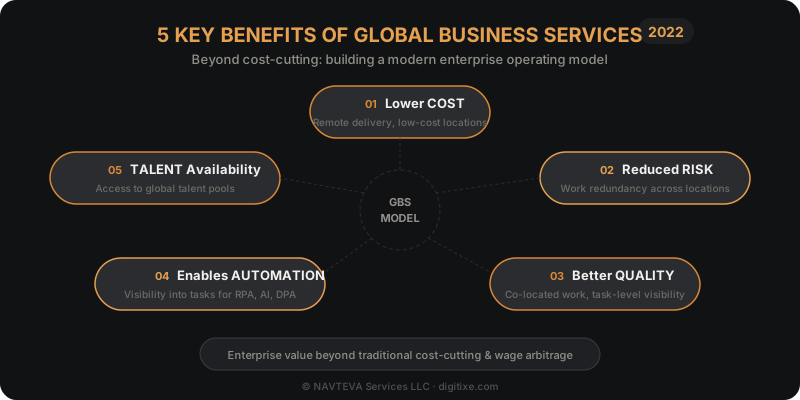
While likely more ambitious than traditional GBS value propositions, my experience with very large GBS programs tells me there are 5 key benefits of Global Business Services:
- Lower COST by delivering work remotely in low cost wage locations
- Reduced operational RISK by creating work redundancy in several physical locations so that work can be shifted around in case geopolitical or staff availability issues arise
- Better QUALITY by co-locating work in the same geography and thus addressing gaps at task level that typically cannot be identified by high level process mapping
- Facilitates AUTOMATION (eg. RPA, DPA, AI) by providing visibility into task details necessary to code software or implement apps; and doing so across enough processes to justify the investment
- TALENT AVAILABILITY Availability by tapping into global talent pools that can deliver work remotely
Moving Forward
People leading the adoption of Global Business Services typically have strong experience with operational improvement, technology adoption and/or workforce restructuring. Yet, most will agree this is a challenging journey full of operational and personal challenges given the level of disruption to both the company as a whole and its employees on a personal level. This dramatic change typically generates quite a bit of anxiety and many of the behaviors associated with large scale change.
Adoption Challenges
- Functional managers and leadership ability to relinquish Control and “line of sight management”
- Trust in remote staff and overcoming cultural misunderstanding
- Overcoming risk & legal, particularly as it relates to licensing, data protection and security breaches
- Fragmented operating platforms that restrict visibility into end to end processes, assignment of people in real time, load balancing work and data mining.
- Interoperability, the need to share resources across functional silos to share staff, reduce cost and enable API services
- Global location selection based on personal preference or heritage
- GBS Leadership team with dominant shared services, outsourcing and cost-cutting experience as it may hinder the ability to get past a cost-cutting, wage arbitrage, model.
GBS is one of the most powerful expressions of operating model architecture — it forces deliberate choices across all four dimensions: what work gets done, who does it, how it's executed, and where. See how a modern target operating model integrates GBS into the broader design. Understanding the architecture of change and adoption is the first step toward designing a GBS model that delivers beyond cost reduction.
Key Takeaways
- GBS integrates Shared Services, Outsourcing, and BPO into a unified operating model
- Five key GBS characteristics: scale, standardization, governance, technology, and talent
- Benefits include cost optimization, risk mitigation, quality improvement, automation enablement, and talent access
- Adoption challenges include leadership alignment, change management, and technology integration