From Future Of Work to Work From Home, let’s tackle 4 basic questions
Much has been written about the Future of Work. Global thought leaders like the World Economic Forum, consultancies like McKinsey, media like the BBC, labour organizations and governments, they have all written, created taskforces and/or practices around this topic over the last five years or so. This makes sense as the irruption of information technology is already being felt across the board and changes seem imminent and disruptive.
After all, Future Of Work, is likely to impact our livelihoods, change behaviors and economic opportunity. Many articles are of great depth, backed by strong research and run the gamut in terms of focus, but the vast majority focuses on jobs, skills and economic impact. Lately, there has been an increased focus in Workplace dynamics given the Work from home (WFH) reality post COVID-19.
As described in my recent article, Future Of Work is far from being a new term, as technology has been disrupting lives and business for a long time, with many studying and predicting new personal and professional life dynamics for decades, if not centuries.
Solving part of the problem
Focusing on what changes: jobs and skills, as the solution to the Future Of Work challenge is valuable but likely incomplete. It reminds me of engineering school when you are asked to solve a math problem, keeping certain variables constant – unchanged. In this case, solving the Future Of Work problem seems to assume an outdated model prevails:
These unconscious assumptions may very well still be in place across the globe but they don’t sync-up with the possibilities of the world we live in, and the realities of several industry leaders. Of course, much has been written about each of these topics, though much more limited in the context of Future Of Work, connecting the dots across the board. In order to move forward, identify and act on the changes to the way we work, we must understand change across four different, yet basic, dimensions.
4
Basic questions for the future of work
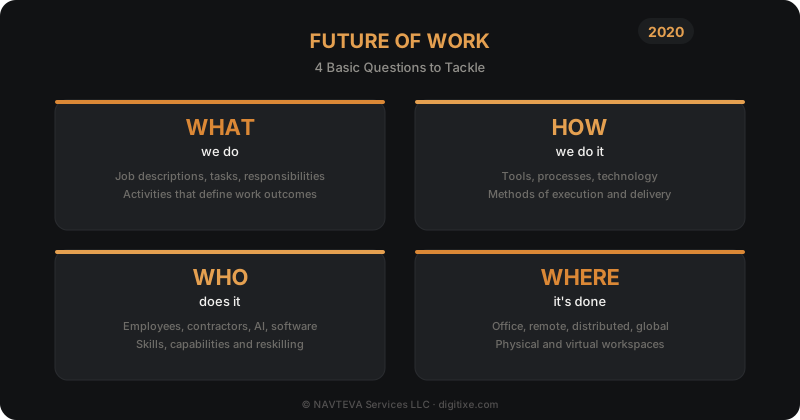
WHAT
we do
Job descriptions typically provide a good idea of what a job entails. It describes the general responsibilities as well as skills, both required and nice to have, across foundational, technical and interpersonal dimensions. The fine print as we all know is that job descriptions become stale and many of the job details come directly from your supervisor.
These responsibilities, whether formalized or not, are being changed or fully replaced by technology whether through specific software or through new workforce arrangements (i.e. outsourcing, gig workers, consultants, etc) enabled by technology connectivity.
There is extensive discussion around what those new skills might be, associating them with new jobs being created and those being phased out due to technological progress. Accordingly, the educational and experience requirements used to recruit these individuals are likely to change.
Jobs & Skills
HOW
we do it
How work gets done has historically entailed significant discretion, driven by supervisors and managers. This is all well and done in a world of functional organizational silos with slow handoffs and responsiveness. And of course, managerial flexibility reinforces the desire to hire the best skilled candidates that can easily adapt and succeed at executing work a supervisor or business dynamics change in a whim.
This traditional model also helps explain why all kinds of business problems tend to be solved by focusing on job skills and organizational structures. Once rules and standards are formalized and coded, you may no longer have to use paper, reviews that you did in the past are no longer required, handoffs are now non-existent or at least not transparent to the user.
OrganizationOps GuidesSoftwareWorkflow
Specifications on how work is done has transitioned over time from personal instructions to physical manuals, detailed user guides, online help and on-demand Computer-based-training (CBT), to name just key examples. As workflows and task specifics evolve more dynamically than before, new technology such as low code/ no code, mergers, acquisitions and compliance will help shape a real-time set of work responsibilities and orchestration more according to modern business dynamics.
WHERE
we work
Geographical business dispersion has a history that straddles between the corporate desire to reach new markets and the ability to connect workers, while complying with local regulation.
Corporations expanded to new markets and cloned their organizations around the country and around the world. As technology evolved (e.g. ERP, Cloud, virtualization, security) and provided the ability to connect remotely while complying locally, organizations started consolidating functions in regional and global organizations, driving economies of scale. As this evolved, pieces of work were carved out to remote locations (i.e. India, Phillipines, Central Eastern Europe, South America, etc) to benefit from wage arbitrage via outsourcing and remote gig workers.
OfficesHomesOffshoreCoE
Then COVID-19 hit and people realized Work From Home (WFH) and Work From Anywhere (WFA) was possible, and in some cases, even better. While some of us have worked remotely for decades, only a small fraction of organizations allow remote work. Now this is changing and just like Yahoo reversed course a years back, the road will likely be bumpy as people learn new behaviors associated with this model. In doing so, several challenges will have to be addressed.
- Culture & Sense of belonging
- Engagement & Communications
- Work handoffs
- Trust
- Building & Driving change remotely
- Security & Compliance
WHO
we work with
Jobs have traditionally been performed by employees, legally binded to an organization. Of course, part time employees and contractors have been common practice for decades, as organizations search for reductions in total employee cost, increased flexibility in cost structures and reduced legal and compliance liability. A strategy applied primarily in “back office” type jobs, deemed to be easily replaceable.
The continuous search for cost savings, combined with limited organizational inertia and core competencies drove an entire industry of external help on both sides of the skill and cost spectrum. On one end consultants with specialized skills that are not economically viable to have in payroll and on the other temp agencies and outsourcers with lower costs and a promise to get even better. A distinction that works on paper but that becomes far more nuanced in reality – McKinsey and Accenture offerings and revenue evolution provide concrete examples.
Gig Workers OutsourcersConsultantsBots
Legal and procurement control made sense when external staff was less than five percent of the workforce but what if the volume and activities under these alternate arrangements grew? Well this is where we are today, with the advent of gig & remote workers, global centers of expertise, low cost outsourcers and high end specialized firms, it is key yo have a coordinated talent network regardless of location or contractual agreement.
Moving Forward
Human Resources, People and Talent organizations are expected to lead when it comes to the Future Of Work. Particularly as it relates to jobs and the skills required to execute them effectively. Yet, this likely won’t be enough to compete and provide the new workforce with the opportunities, experience and success available in the digital age.
Business change dynamics, continuous flow of work and customer demands, drives the need for a reliable and agile operating system. One that addresses continuous changes on how work gets done, constant workflows across multiple locations where work gets executed, shifts in skills required to do the work efficiently, and engage the wide set of workers available to do the work. This yields the need to articulate, build, transition and optimize a modern operations infrastructure (a.k.a. Digital Operations Model) to keep up with the times.
These questions sit at the heart of designing an operating model for change and adoption — integrating workforce, technology, process, and geography into a coherent design. Start with what architecture really means in business.
Key Takeaways
- Four basic questions frame the Future of Work: WHAT, HOW, WHERE, and WHO
- Solving only part of the problem creates new imbalances
- Work-for-life and line-of-sight management are giving way to new models
- Each question requires rethinking established assumptions about work